Monday, 13 October 2014

Ahhh... chocolate!

As promised, today I'm continuing on in the theme of cacao.  Last post was about the raw state, but today is about the finished product, and how a group of women is using it to make a difference in the lives of their families and in their community.

In the happening little town of Chazuta resides an interesting and delicious business called Mishky Cacao.  I have been told that this is Quechua for "Tasty Cocoa" and I can say with absolute certainty that the name suits very well.

Our visit took place at the same time as our visit to the Allima Cacao cooperative that I featured in the last post.  Indeed, they are linked closely.  After our educational and fascinating visit to Allima Cacao we stuffed ourselves into our mototaxis and headed off up the road back into town. On the way up the hill from the plantation, the lead mototaxi hit a deep hole and nearly tipped. 


Our host leaped off the back of the motorcycle he was riding on and heaved the mototaxi upright again, then helped it get up the hill by pushing on the back. The passengers leaned forward as far as they could and the machine managed to get up the remainder of the slope.  Crisis averted, we roared back to town, where we encountered another rocky slope.  Carrying three large Canucks in the machine was obviously more than either machine or driver were accustomed to.  He paused at the base of the hill, surveyed the rocky surface and then shouted and waved away the motorbike and pedestrians on the hill. They scurried for cover, he gunned the engine and we roared and bounced and rocked our way slowly up the hill.  Engine grinding and smoking, tires making popping noises on the rocks and with the three of us laughing hysterically in the back, the driver leaned forward and willed the machine up the slope.  I could see the veins in his neck stand out with the strain, and I am certain he was also grinding his teeth with the effort.  By the time we reached the top of the hill the machine was nearly at a standstill, but we finally bunny-hopped over the lip of the hill and hit the straight-away that took us to our destination. 


Mishky Cacao is housed in a tidy bright pink little building, and you can smell chocolate before you even open the door.  On stepping in, we were greeted like long lost friends by four women inside.  We were embraced heartily, and once introductions were made we were offered chairs to sit on for a presentation. The space was pristine clean, and had a variety of small machines in place for the processing of the cocoa beans.  One was a grinder that processed the perfectly aged beans to a fine powder.

This grinder was small but very effective, and apparently a huge improvement over the previous model in terms of its ability to produce the fine cocoa powder needed.  There was another machine containing a smooth pale brown liquid, in which large paddles constantly mixed and churned.


It smelled heavenly, and turned out to be liquid milk chocolate, being prepared for truffles and candies.  There were also some intact cocoa pods sitting on another machine, presumably for demonstration, along with a pair of greenish and deeply wrinkled large pods of some other type which at first I took to be a different type of cacoa. I was both right and wrong, as I was soon to discover.
 
After some hugging and visiting, one of the women seated us all on plastic chairs and began to tell us about Mishky Cacao.  It was born in 2009 when a group of thirteen women in Chazuta envisioned a business that produced artesanal chocolate products.  It had its humble beginnings in a back yard, without financing and with very few tools. Today it is housed in this small but efficient space, and is thriving.  It produces many types of chocolate products, and more are in the process of being created.


As I was to learn from our hosts, the large green wrinkly dinosaur of a fruit is the Majambo.  It apparently grows freely and with abandon in the same area as cacao.  In fact it is a wild relative of cacao, an ancient fruit that has been consumed by Peruvians since forever.  The fruit inside is yellow when ripe, and the seeds are covered with a sticky fibrous pulp.  The women in the Mishky Cacao cooperative came up with the idea of adding the Majambo fruit to chocolate and a delicacy was born.  The resulting  combination is smooth, buttery and rich, and there are tiny grains of coffee beans along with the delicious creamy majambo.  I have no photographs of this product, happily, because we ate it.  All of it, and quickly.  The seeds of the Majambo are also used, toasted, and have a crunchy nutty flavor, slightly bitter initially and completely addictive. We had an opportunity to ask questions about the processing of the chocolate, and were invited to sample more of the products.  We all purchased chocolate in various forms and types, from 100% pure cocoa to milk chocolate and drinking chocolate.  It is without a doubt the richest and most delicious I have ever tasted.

The women in this cooperative are obviously and understandably proud of what they have accomplished.  They have built a successful business from the ground up and are continuing to grow it.  Most importantly, this little business has improved the quality of life for these women and their families.  Entire families are involved in the process of growing, harvesting, processing and transforming the cacao, from tree to truffle.  It enables women to improve the income of their families, and still to raise their children and be present for them.  We were told that both the men and many of the older children work at the plantations which supply Mishky Cacao with its cocoa beans. It is truly a family affair.  It has also brought a sense of pride and accomplishment not only to the women and their families, but also to the community as a whole.  Somehow that just makes the chocolate taste so much better. 


And that is the sweet story I promised you.  Life is sweet, chocolate is one of the things that makes it sweeter.  But the next time you purchase chocolate, think about the work that goes into growing and processing this delicacy.  Instead of slamming any old chocolate bar, go out and choose some high quality, fair-trade chocolate, and savor it.  Let it melt in your mouth and think about the people who depend on it for their livelihood.  What you buy really does matter.


And so we come to the end of another post, another story.  I will be back soon.  Hasta luego, amigos y amigas.

Saturday, 27 September 2014

Cacao - Food fit for the gods

One of the things we've had a chance to do while here in Tarapoto is to visit a cacao  (pronounced "ka-kow") plantation in Chazuta that CUSO has been partnered with. Being a farm girl this interested me anyway, but put chocolate on a farm and I AM THERE!  It was a great day in a very interesting little town, as well as another opportunity to see what CUSO is involved with here regarding economic development. 
 
We had an early breakfast and headed out to rent taxis, as it's almost a two hour drive to Chazuta.  Distances are deceiving here if you only look on a map.  Weather, road conditions and pit-stops on the journey can all contribute to a trip unlike the one you planned. 


At the taxi depot some mild negotiating took place, and we found ourselves hiring two cars with space for a woman, her rooster, and all of us.  We climbed aboard, rolled down the windows and along with our feathered companion, rumbled off down the road.

We had left early for Chazuta because we had a lot planned for the day, but as luck and Peruvian roads would have it, we were delayed halfway to our destination.


For those who might be tempted to think that a mere rope is never going to get between you and an open road, a word of warning: the road beyond just isn't.  Not only is it not an open road, it isn't a road.  At all.  In its place is a cratered moonscape of near epic proportions, apparently not an unusual occurrence in this area, especially in the rainy season. While horses and people on foot could and did pass through with impunity, we had to sit this one out, finding a scrap of shade where we could. 


A sweaty hour later we were on our way again. We bounced our way slowly through the mile-long construction zone, then, with the windows wide open, the remainder of the trip flew by and we arrived at Chazuta in short order. 


Our hosts greeted us at the town office where we were welcomed as the new CUSO voluntarios.  We then enjoyed a discussion on economic development initiatives, much of which could not be heard due to the ongoing excavation of the street outside.  I must admit, however, that with my primitive understanding of Spanish, hearing probably would not have helped significantly.  After sharing a massive bottle of Inca Kola, we stuffed ourselves into mototaxis and headed out of town towards the cacao plantation.


Allima Cacao is a cooperative, where the cacao is grown, harvested, processed and sold by members of the co-op. The science behind this process is surprisingly complex. At least to me it was, because I really had NO idea how chocolate came to be.  I was just happy it existed. 
 
Chocolate grows on trees.  Yes, it does.  They are pretty trees, on the squat side, and pruned extensively.  The blossoms are tiny and delicate, and grow directly from the main trunk and branches. 


The leaves are copper-colored when young, silky in texture and almost transparent. 
The mature leaves are leathery and dark green with heavy veins. The type of cocoa plant we saw on this plantation grows and produces all the time, while there are other cultivars with a more distinct time for production.


The fruits are oblong, about 8 inches long when mature, and have a thick deeply wrinkled skin, leathery in texture and a deep wine red in color. Some of the fruits can be orange or a lighter red.


The fruit is heavy for its size and when mature has a duskiness to the skin, as if it were covered in wax or dust.  It is at this point that it is picked for processing. 


It is hand-harvested, the fruit cut off the tree with a type of pruning shears and placed in a jute bag which the harvester carries on his/her back with a long strap up and around the forehead.  The fruits are handled carefully to prevent bruising.  The harvest is taken as soon as possible to the co-op for processing.  This may in some cases involve a long boat journey and getting the bags down from the growing areas to the river. 
The next stage of harvest is where it gets even more interesting.  The pods are split with a dull machete to avoid damaging the internal seeds or grains.


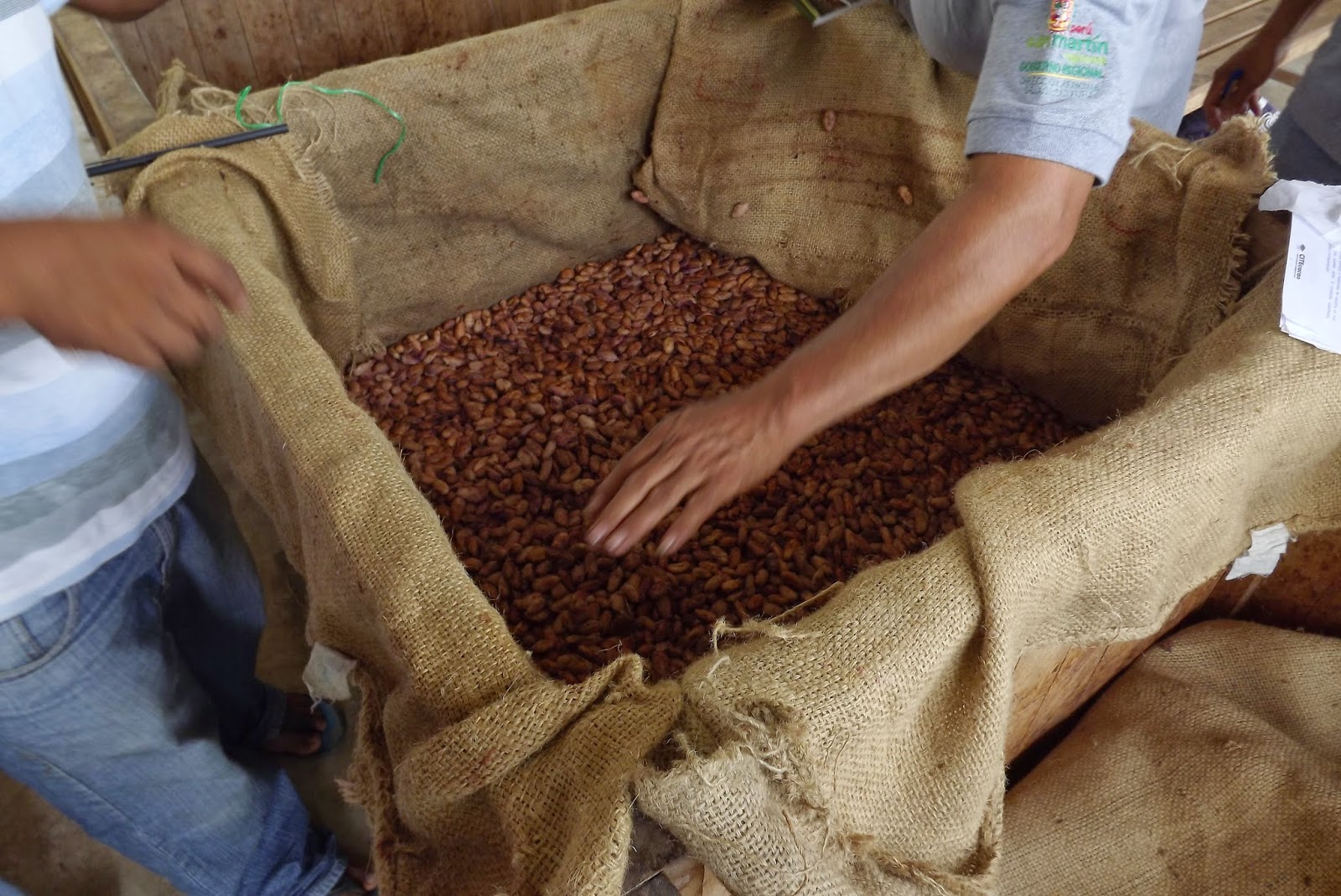
The seeds and their accompanying jelly are checked to make sure they are healthy-looking and the whole "dough" as it is called, placed in wooden drawers lined with jute.


The dough is covered with plantain leaves and a layer of jute to favor fermentation. 


The seeds are
fermented in their dough for 48 hours in the first drawer, then every 24 hours they are moved to a new drawer, also lined in jute.  Moving is done quickly to avoid heat loss, as even fermentation is necessary for the best chocolate quality. 


Once properly fermented, the seeds are laid out in layers about 3" thick on mesh tarps laid over cement slabs.  They dry slowly in the sun.  They are stirred every hour for the first day, then every two hours for the next, to facilitate a slow drying process. 

On the third, fourth and fifth days, they are placed in thinner layers to continue drying, and once they reach a humidity of 7.5% they are ready to process.  They are also stable enough to store at this point.

The seeds are then collected and checked for impurities and defects, and bagged for storage in jute bags.  These are placed off the ground on wooden pallets and stored in warehouses where they are out of the rain but where air circulates freely around the bags. The seeds are quite porous and absorb odors easily so care must be taken in their storage.


From here the cocoa seeds go for processing to be made into cocoa powder and that delicious confection to which many of us are addicted-CHOCOLATE in its many forms... 


But, that is another whole story, and one I will be happy to share with you next time.  For now, my friends, may dreams of fermenting cacao beans fill your heads.  I will return with the rest of this sweet story in my next post. 

Hasta luega!


Tuesday, 23 September 2014

The Secret Garden

Welcome back!  I had a particular subject in mind for this week's blog, and after this weekend I completely changed my mind.  Why?  Because Sunday was the best day yet here in Peru, and needs to be shared with you.  

One of the organizations Murray is working with here is a producer and marketer of high quality medicinal plant products, using traditional medicinal knowledge and plants grown in the San Martin region. They source their plant material through people in local villages who harvest them from the jungle in a sustainable, ecologically-sensitive way, the way in which it has been done for generations.  We were invited to go along on a visit to an area where plants are harvested and to meet one of the families involved in this small but important industry.

Our day began with a 5:45 wakeup and a quick cup of tea before we hopped into a mototaxi and headed to a taxi depot to meet our travelling companion.  By 7 a.m. we were seated on plastic chairs in the depot, waiting for more people to show up, because the cars going to outlying areas don't go half full.  Our traveling companion was going to take his motorcycle to the town, so that left us to take up half a taxi.  Within a half hour, the quota was met, with the other half made up of a gregarious young man still sporting the effects of a night of partying and a woman who (happily) was seated in the back seat with us. We flew out of town heading in a westerly direction, not really knowing where we were going, but our traveling companion had given the taxi driver instructions, so we trusted we were in good hands. 

The roads are shall we say, interesting, around here.  I theorize that there are few or no curve signs on the roads because there is never a long enough straight-away to put one up, and no one cares anyway.  Both sides of the road are put to good use, regardless of who else is on it or which direction you are headed.  The young man in the front seat belted himself in, (an unusual occurrence) which gave me cause for momentary anxiety about the road ahead.  Then I realized it was because he intended to pass out and without the seatbelt he would have been flat out on the driver's lap within moments of our departure.  He slumped in the seat, swaying from side to side, head bobbing, while music blasted on the cd player.  Our cab was very clean and quite new, and the woman in the back seemed not to take offense when the sharp curves threw both Murray and I on top of her.  From time to time the cab driver would elbow the young man off his shoulder and back into place or Murray would reach between the seats and heave him back into place. He snored softly the entire way. The drive lasted about 1 1/2 hours, and took us through several small pueblos on the way. The views are absolutely breathtaking, so I was madly clicking the camera at every opportunity. 


We arrived finally in a small town called San Juan de Sisa, where we unfolded ourselves from the cab and met our travelling companion. He had arranged for a mototaxi to take us the rest of the way to our destination which was Chirik Sacha.  This community is the home of a woman who is the president of the local medicinal plant cooperative in the area, comprised of residents of several surrounding communities.  The cooperative and the work associated with it are solely run by women, whose husbands and families are occupied in other agricultural endeavors. 
Arriving at Chirik Sacha we pulled up in front of a thatch-roofed pole home, and were cheerfully welcomed by a woman, her elderly parents, her husband, and their young daughter. 

We shook hands, embraced and then entered their home.  The first introductions were made, then we sat on a wooden bench and were given cups of chicha to refresh us.  Chicha is a traditional Quechua drink made from fermented corn.  It is not at all sweet, and has a slightly musty, though not unpleasant flavor. As well as the chicha, we were given fresh papaya and oranges from the trees in the back yard which were so juicy and delicious that eating them ended up being a full-body experience. After a few more minutes of conversation and getting to know a little more about this family, and they us, we were invited to go down into the little valley behind their home where fruit and medicinal plants are grown. All the plants are native to the area and grow in a natural micro-ecosystem, here in their "backyard".  Mango and orange trees, avocadoes and papayas grow throughout, side by side with plantain trees. 

Beneath the trees are the medicinal plants, some of them vines, some shrubs and upright flowers, some small ground dwellers and some in the process of becoming trees, a process that
may take up to 40 or 50 years.  We wandered through this wild garden, getting a lesson in the plants and their uses.  Plants for psychological healing, for arthritis, cuts and bruises, and kidney stones.  Plants for improved digestion, for bathing colicky babies to soothe them, and plants with strong antiseptic properties.  Every need is covered in this place, and the knowledge that goes with the use of these plants is handed from generation to generation. 


Following our walk in the garden, we were invited back to the house, and offered lunch. The people here often do not have much in terms of monetary wealth or property, but what they have is generously shared with guests. We were served a delicious meal of chicken, rice and plantain, all cooked with herbs and vegetables that they grow in this garden of theirs.


We sat in the simple kitchen, laughing and sharing the meal, as people do the world over. 
Language and cultural differences mean very little when people meet with the goal of understanding and respecting each other, and to share their stories.  We played ball with their little girl, put temporary tattoos of the Canadian flag on her arms, and had an impromptu lesson in how to spin cotton. 
Our broken Spanish was cause for mutual humor, but never ridicule, and we were made to know  that we were most welcome in this home. 
 
After a few hours of visiting, we were invited to join the association of plant producers at a meeting and in their gathering of plants, but on further questioning found that the last of the two taxis out of Sisa would be leaving shortly and if we weren't in it we would be out of luck for a ride back to Tarapoto.  In addition, the skies had turned black and a stiff breeze had come up.  A flurry of consultation between our friend and our host ended with him running into the village to find a mototaxi to take us back to Sisa.  About 5 minutes later he was back, along with a mototaxi willing to drive us up the bumpy road to Sisa.  We said goodbye, with many hugs all around, and were presented with a big bag of starfruit and vegetables, a handmade clay teapot, and a handwoven belt for Murray. As the skies opened up, thunder crashing around us, we scrambled aboard the mototaxi and were admonished that we must come again, and next time for a longer visit.  This is an invitation we are both eager to accept.
 
The ride back to Tarapoto was a quiet one, as we reflected on the day.  The poor woman squeezed in next to us had no choice but to put up with my squashing her on the tight turns of the corkscrew ride back to the city. After many apologies from me, she finally threw a sweater over her head and went to sleep on my shoulder. 
 
And so, my amigos, goes the story of the Secret Garden.  We had a wonderful day exploring the world of traditional medicine and medicinal plants in their natural state.  We had an opportunity to see the importance of traditional medicine in the cultural sense as well as the economic sense. We got a glimpse into the lives of a generous and warm family, and in the process made new friends.  To my way of thinking, that is really the most important part of what we do here- to create relationships and promote understanding between vastly different cultures.  La amistad.  It just doesn't get any better than that.


Monday, 15 September 2014

Tarapoto: City of Palms

Tarapoto.  What can I say about Tarapoto?  Well it's everything I expected and nothing like what I expected.  Tarapoto makes Lima look like an elderly lady in sensible shoes.  Hot, humid and incredibly noisy, Tarapoto is a city of pavement and mototaxis.  The palms?  Well they're certainly out there, but nowhere near where we're camped.  I had expected more trees, after all this is the jungle, but in downtown Tarapoto where we're stationed and will be living for the next 6-8 months it's all cement.  That's not to say it doesn't have its appeal.  It does, and I must hasten to add that although it's different than the image we had of it, Tarapoto has not disappointed us.

Some local color

We are still living in a hotel/hostel called the Sol de Selva.  It's a small, intimate family-owned hotel, and as welcoming as a weekend at Grandma's.  The family is gracious and warm, and the hostel itself pristine clean.  We are treated royally here.  Every morning begins downstairs where the group of CUSO volunteers gathers for breakfast and coffee before heading out on our daily rounds of meetings and information gathering.  Pedro, the owner's son, has trained as a chef and makes the most delicious breakfast sandwiches for us every day, full of flavor and color, and served with a cheerful smile.  It will be hard to leave this place and its comforts when our house is ready for us.

This week has been a real eye-opener.  From every perspective.  It's been exciting and exhausting.  The areas CUSO is primarily involved in here in the San Martin area are tourism, cacao (chocolate) production, and medicinal plants.  These sectors are all part of the San Martin region's green initiative, which focuses on developing sustainable agriculture and tourism, while trying to preserve some of the rich traditional culture.  Each day has been crammed with meetings with local organizations that CUSO  works alongside in these sectors.  We have been introduced to dozens of people and had briefings on each organization's focus and challenges.  The network of projects and plans for development and economic growth here is amazing. 

We've enjoyed the novelty of the heat, though admittedly we are wilting by our 3rd or 4th meeting of the day.  And did I mention that all our meetings have been conducted in Spanish, accompanied by a cacophony of hammers, revving motorcycles, construction noise and ringing cellphones?  We have been zooming from meeting to meeting at high speed, stuffed into mototaxis since we arrived.  It's the pause that refreshes, and I look forward to it every time.


Getting around in a mototaxi is a little like visiting Disneyland.  You just hold on, enjoy the wind in your face and forget about little things like personal space.  

We arrived here with two other new volunteers, one of whom will actually be stationed in Lima with some visits out to the San Martin region. The second is stationed here in Tarapoto with us and he will be working in the tourism development sector. Then there's us, with Murray working with the medicinal plants sector and me looking to plug in where I can be useful.  Another volunteer is due to arrive the end of the month to work in the cacao sector. Throughout the week we've had the pleasure of meeting other volunteers in place here, from CUSO and other non-governmental organizations. 

CUSO's role in international development is integrative, with its volunteers working alongside partner organizations already present in the area.  These partners are involved in micro-financing, small business and cooperatives and specialized areas such as medicinal plants.  They are building from the ground up.  There is so much un-tapped opportunity here, an incredible richness and variety of natural resources existing alongside a profound level of poverty in many areas. The scope of what could and should be done is overwhelming, and we have to keep reminding ourselves that our part is but a small piece in the puzzle.  Each piece looks insignificant alone, but is essential in forming the overall picture.

                       A glimpse of the potential here           

Has it only been a week here?  Feels like we've packed in enough for a month already.  In addition to our packed meeting schedule, we have also travelled out to Moyobamba, a two hour drive from Tarapoto, to visit a nature preserve/ecotourism project, to Chazuta to visit a cacao plantation and chocolate factory as well as a pottery guild, and made a trip to Lamas to see the Italian castle and the coffee house.  Oh yes, and Murray hiked for 6 hours in the jungle with some new friends. 

But those, my friends, are stories for another day.  I leave you with this thought:  the world out there is seldom what you had in mind, but can always be better than you expected.  When next I write I hope we are installed in our new home here in the anthill that is Tarapoto, and I will have more details on the projects we are seeing and becoming involved here in the selva.  Until next time, salud!  Stay frosty amigos!

Saturday, 6 September 2014

Life in Peru begins...

We've been in Peru for only 5 days, but what a full five days! We've been staying in a small hotel, called the Casa Kolping.  Each day has looked something like this:
Wake at 6:45, shower and dress then go downstairs to have breakfast with some other volunteers.  Breakfast is crusty rolls, thinly sliced ham, a mild white cheese and local jams that are tasty but which I still cannot identify. The coffee is dark and so strong that it's almost syrupy, and I drink it black with a tiny bit of the coarse brown sugar that is provided.  It's different, but good, and gives a caffeine kick that is much needed to stay awake and focused on what we need to hear each day. 


Coffee, hot and strong.


We then walk the four or five blocks to the CUSO office and begin our training sessions, on safety, health, intercultural relationships, politics and history. Throughout the days we have enjoyed forging new friendships with the other volunteers and staff of CUSO.  I am so very impressed by their dedication and passion, and the variety of life experiences and training that they bring to the table.  I think these relationships will be one of the best things about our time in Peru.

All of our training is conducted in Spanish, which has been an enormous challenge to us, but a good one.  If we are ever to become functional in the language, immersion is the only way.  It's been a crash-course in learning to listen.  Listen to every word, every syllable, every letter.  When the traffic noise overwhelms the words of the speaker, and we appear to be confused, another volunteer or one of the staff steps in and translates the most essential parts.  It's been exhausting, humiliating and exhilarating all at the same time.  We certainly have more Spanish than the day we arrived, but much much less than we require to function well here.  We find ourselves exhausted at the end of each day but we are learning.  The ears are beginning to hear what they need to hear, and the next step is getting the mouth to say what the brain is thinking. 

We have a huge amount of admiration for people who learn another language.  I never thought about how difficult that process is before.  When you think and dream in a language, everything is intuitive, and you search only for the best way to express yourself.  When you are learning another language, you search for the words to say even the simplest thing.  It is a humbling experience to be a person who loves and manipulates words yet finds herself fumbling for the words to say anything at all.  However...I do feel as though I am on the brink of discovering the language, that somehow it's all going to start making sense.  I have many pieces of the puzzle, and now need to start putting them together. 

We have not had much time to discover Lima, with our full days of training.  We have walked a few miles though, and have been impressed with the little we have seen.  It is a city of incredible energy.  You get the sense that chaos is barely restrained.  People shout, laugh and talk loudly.  Horns honk constantly and obnoxiously. Rattling mini-buses stuffed to capacity roar by, belching exhaust fumes.  Money changers exchange currency on the street medians, and they will give you a better exchange rate there than anywhere else in the city, including banks.  So when there's a break in traffic you cross to the median, haul out your money and make the transaction. 

You take your life into your hands trying to cross a street. Yesterday a group of cars was approaching the four-way intersection in front of our hotel, and appeared to be slowing for the stop sign.  After a few days here, I realize that this is an illusion, but I thought I had plenty of time to cross the street.  I stepped out just as the first of the drivers gunned his engine and roared through the intersection.  I did a skip-hop across the road in record time while my wiser companions waited for another break in the traffic.  Speed bumps, traffic signs and stop lights are mere suggestions here, mostly ignored.  Everyone seems to know what to do though, and there is a constant cacophony of horn honking that apparently indicates who goes where and when.  A pedestrian has zero rights here, and if you are crossing you have to dodge the cars turning in front of you or behind you because they will not stop to allow you to pass.  Ever.  Surprisingly though, we have felt safe here, and the city's energy seeps into you rather than drains you.

Looking out the windows of the office, you see across the road a government building where gun licenses are issued. Each day there are long lineups, all day, of men waiting to be admitted to purchase a gun permit.  One of the good jobs here is as a security guard, and guards are ubiquitous, in grocery stores, on the streets, outside of restaurants, stores and banks. Many carry hand weapons, so a gun license is worth standing in line for, all day if necessary.
 
We have discovered some of the delicious foods here.  One of my favorites is a fresh avocado, peeled and halved, then stuffed with a flavorful mixture of chopped chicken, sweet peppers, tomato and cilantro, with a spicy sauce drizzled over it all.  Anticuchos de corazon are also tasty, but not necessarily for everyone.  They are pieces of beef heart, rubbed with a mixture of garlic, aji pepper and cumin.  They are grilled on a skewer, and served with or without a creamy, spicy sauce.  We enjoyed them very much and will certainly have them again.  Chicken is served everywhere, in all forms, as are many of the 4000 varieties of potatoes grown in Peru.  At a small cafĂ© where we had lunch this week, chicken came in the form of chicken feet soup, apparently tasty and filling according to Murray, but not something I was ready to challenge myself with yet.  There is goat, beef, pork and llama too.  Nothing I have tried so far has been disappointing.  And, happily, (probably luckily) the digestive system has held up to this point.  We shall see if that continues to be the case. I think we will have some interesting culinary adventures here.
 
 
Culinary adventures abound in Lima
 
So, here's what we've learned in our first week here in Peru:

~Energy, noise and boldness characterize Lima. This city with so much history continues to recreate itself.

~We are a very small piece of the CUSO puzzle.  People from all walks of life are contributing to and learning from this type of experience.

~We are in dire need of language learning assistance.  Happily it sounds like a language teacher is being looked for to help us in Tarapoto.

~We are just beginning a great adventure, with many challenges ahead.


Please stay tuned for our next post, which will be coming soon from Tarapoto.  Thank you to everyone who has supported us financially in this and with their prayers and messages of encouragement.  We really couldn't do this without you.  Hasta luego amigos!

Friday, 29 August 2014

Adios Winnipeg!

WOW time has flown by!  We're less than 3 days away from our flight to Peru and I think (maybe) we're ready (nearly).  Chaos reigns supreme here, with little piles of stuff everywhere:  to take, store away or to make a final decision on.  The new tenants are nearly in, and our suitcases stand ready for packing.  And if the washer holds out, a final load of laundry awaits.

We had a wonderful evening last weekend doing a car rally fundraiser.  It was great to visit and talk about our upcoming adventure, and the rally itself was fun too, once we managed to find our way out of the driveway.  Of the four in our car, two had never done a rally and the other two hadn't done one for at least 25 years.  There were two navigators, one grumpy one in the back seat who couldn't figure out ANY of the clues, and one in the front who was cheerful and clever but whose Spanish accent got thicker the more excited she became.  We very nearly needed a translator, and had to "phone home" for clarification three times in the first 1/2 block.  Eventually we did get into it though, and managed to do reasonably well.  A significant bonus to skipping one-third of the clue list was that we arrived back early and were the first to taste the great food.  The best part of the whole event though, was being surrounded by friends who care about what we're doing and wish us all the best.  Thanks guys!  We are so grateful for you all.

This last week has been a series of little challenges.  Doesn't that always happen when you're getting ready to do something important, or you are pressed for time? 
~My brain decides that it is not going to absorb even one more word of Spanish.  No sir-ee. 
~The credit card gets hacked and has to be cancelled, less than a week from departure and right before the long weekend. 
~There's suddenly an unpleasant and unidentifiable odor in the basement and the source cannot be found or eliminated. 
~I lean on the stove as I'm talking to my son and scorch my hand on an element I didn't know was on.  (I'm typing this with pinky and thumb on one hand as the rest is now medium-rare). 
~The washing machine begins to do the rumba across the floor and the elderly dryer develops a ear-splitting squeal as we're starting the umpty-seventh load of laundry.  Then the one light in the laundry room decides to quit altogether and laundry has to be done in the dark.  It's like being in a scene from Poltergeist in there.  
And through it all it continues to pour rain.  Pour.  On the chair cushions I forgot to bring inside. 
Hmmm.  These are small but penetrating annoyances. 

But we are not defeated.  If these things are enough to discourage us, then my friends, we'd shouldn't otta be going to Peru.  Instead, I see them as signs that we MUST go.  We have important things to do.  And go we shall.  We have been so encouraged by the phone calls, texts and emails from friends as well as the boatload of generous donations to our fundraising goal.  We're now at just over 70% of our goal thanks to YOU.  You have blessed us and supported the work of CUSO.  We thank you from the bottom of our hearts! 
Also on the bright side:  we've managed to deal with all but the light and the squeal in the laundry room and those are supposed to be fixed tomorrow.  (Maybe.)

So... hasta luego mis amigos!  I hope to pen my next message to you from la gran ciudad de Lima, Peru.  Stay cool and stay tuned.


Friday, 15 August 2014

Tarapoto Bound


This is what most people think of when they hear the name "Peru".  Incomparable beauty and mysterious history.  It is this, yes, but so much more than this...
As we experience and share our time in Peru with you, I hope that you will get a sense of what life is like there, beyond the well-known areas.  This is one of the most exciting things for Murray and I to anticipate.

One of the reasons why Murray and I wanted to volunteer for CUSO is also one of the main reasons for CUSO's success in developing countries: they send people, not money to areas that are in need.  Sharing knowledge educates and empowers people on both sides of the equation, and makes for a deeper understanding between different cultures.  So much of what makes life work and makes development initiatives successful are the relationships that develop when people come together to share their experiences.  The implications of that reach far beyond the project itself and last long after the volunteer returns home.
 
I (Lynette) am going as an "accompanying partner", that is, I am not an official volunteer.  However, I have been told that there will be someplace I can plug in and serve also, whether that be through CUSO or through another volunteer-based organization in Tarapoto.  I am eager to share any skills and experience I have that might be useful there.  I will keep you posted as to what I get involved in as well as what Murray is doing.
 
Here is where we are headed:  Tarapoto, Peru.  Tarapoto, "City of Palms" is located in the northern half of Peru, about an hour flight time from the capital city of Lima.  Including outlying communities its population is about 120,000.  It's considered to be in the high jungle plateau (also called the cloud forest), 356 metres above sea level.  It is often used as a starting point for tourists visiting the Amazon Rainforest.


For more detailed maps of Peru, particularly the Tarapoto-San Martin area, have a look here .
 
 
 Temperatures in Tarapoto through the year average about 27 degrees Celcius.  It's often hotter than that though, in the 30-35 degree range.  We will arrive in September, one of the hotter months of the year.  With an average morning humidity of 96% I fully expect to be in a constant state of overheating, with frizzy hair a permanent fashion accessory. 
 
At this point we have no idea where we will be living, and we are trying to have no preconceptions about what lies ahead.  We do know we'll be living in the city, but that's about it.  We are hoping for a "real" toilet, but that's about all that's really critical.  (Well ok, a shower of sorts would be nice too.) Part of this whole experience is to learn what we can live without.  I'm betting we can do quite nicely with a lot less than we've thought possible before now. 
 
These last couple of months has been a whirlwind of activity:  Doctor's appointments, vaccines, medical clearances, paperwork and more paperwork.  Oh yes, and training sessions online and in Ottawa, packing up what no one else will need while we're away, and arranging all the things that do need to be in place for our family.  We're also trying to find time to stuff as much Spanish into our noggins as we can, and to visit with friends and family before we leave.  Throw in work, a family wedding, and moving a relative to a new home and you have a recipe for busyness.  But it's all good.  And necessary. 
 
I have a friend from Columbia who has (very kindly and patiently) been tutoring Murray and I in Spanish.  She never laughs at us, only with us.  She listens to us butchering her beautiful and musical language, and tells us how well we're coming along.  She encourages us to be brave.  It has occurred to me, just recently I'm afraid, that she has done what we're doing, only in reverse.  She has struggled with learning English, making friends, and surviving our -30 something winters.  Her move to Canada has been a struggle and a sacrifice, but one she deems a worthy one.  Surely we can do the same.
 
So this week is about Spanish lessons, continuing to prepare the house and family for our time away, and last minute visits.  The family wedding will occupy our thoughts and time this weekend, then we'll be into the final flurry of activity in preparation for leaving.  So far, so good.
 
Have a good week, and check back in next time to see if we've completely lost our minds yet or not.  :)  If you would like to support us in our fundraising goal, please click on the link at the bottom of the page.  Any and all donations are MOST appreciated.
 
Hasta luego!